
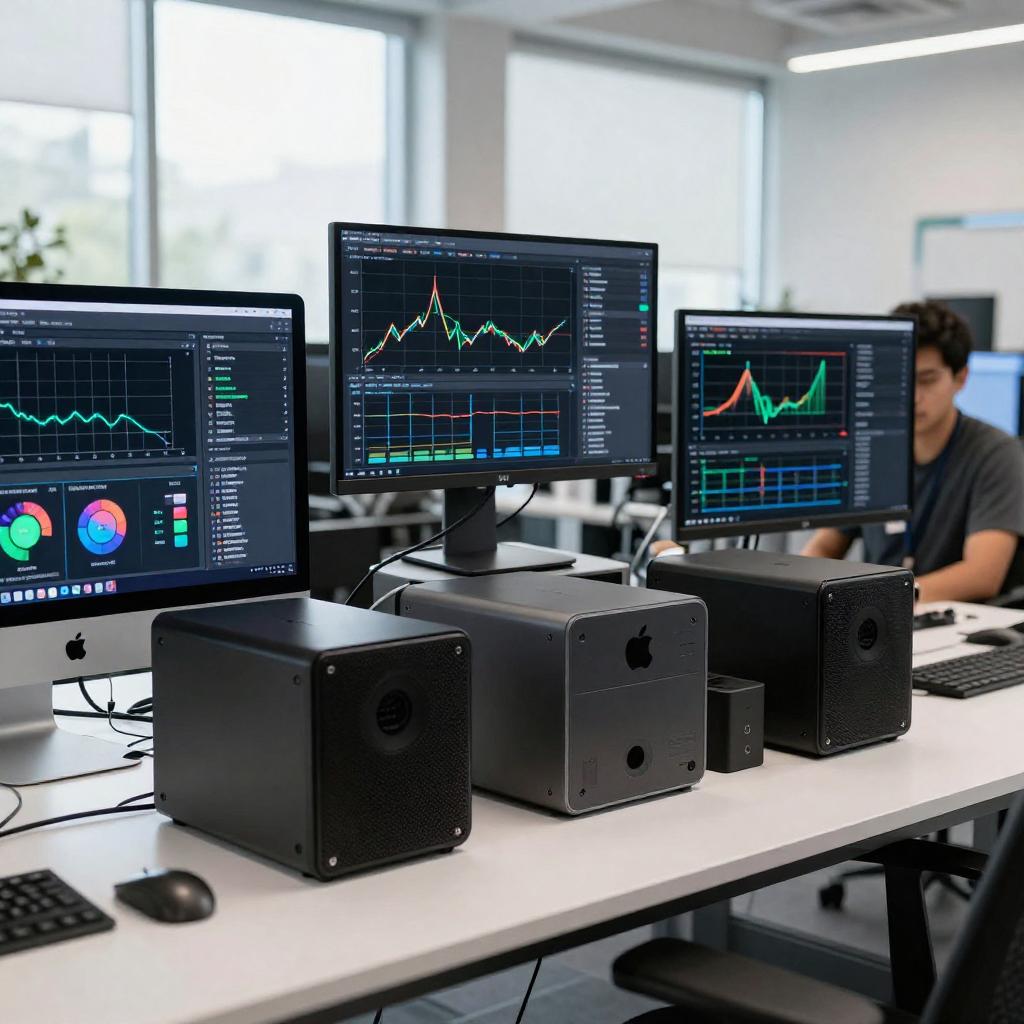
In the fast-evolving world of artificial intelligence, hardware plays a crucial role in delivering the performance needed to process massive AI models. While NVIDIA has traditionally dominated the AI computing landscape with its powerful GPUs, Apple has quietly made groundbreaking strides with its Mac Studio systems. By cleverly integrating advanced hardware connectivity and innovative software, Apple has enabled users to run large language models (LLMs) locally and efficiently, creating AI clusters that are both powerful and cost-effective.
Revolutionizing AI Clustering with RDMA over Thunderbolt
A major breakthrough fueling Apple’s AI capabilities is the inclusion of Remote Direct Memory Access (RDMA) over Thunderbolt 5 connections in the latest macOS version. This technology enables ultra-low latency, direct memory-to-memory communication between Mac units, drastically reducing the overhead caused by traditional network stacks. The Thunderbolt 5 interface itself offers blistering data transfer speeds up to 80 Gbps, ensuring that computational resources across multiple Macs can sync and share data almost instantaneously.
This bandwidth and low latency unlock performance improvements unseen in previous multi-Mac configurations, letting users build clusters that seamlessly aggregate their CPU, GPU, and unified memory resources.
Hardware Powerhouses: Mac Studios with M3 Ultra Chips
At the core of these AI clusters are Mac Studios equipped with Apple’s M3 Ultra chips, which combine high-performance 32-core CPUs, 80-core GPUs, and 32-core Neural Engines under one silicon package. Uniquely, Apple’s architecture features unified memory that is shared across the CPU and GPU cores, allowing up to 512GB per Mac Studio.
When clustered, four Mac Studios collectively provide around 1.5 terabytes of unified memory, forming a formidable system capable of loading and running massive AI models that typically require data center scale resources. This massive shared memory pool boosts capabilities to run trillion-parameter models that previously demanded costly and power-hungry GPU setups.
Exo 1.0: The Software Making Mac Clusters Reality
Enabling this hardware synergy is Exo 1.0, an innovative open-source software tool designed to orchestrate Mac Studio clusters through the RDMA-enabled Thunderbolt connections. Exo abstracts the complexity of distributed computing by pooling memory and compute power from multiple Macs into a unified resource accessible as if it were a single system.
Through Exo, users can deploy and manage large language models efficiently, gaining significant speedups in inferencing tasks. For example, running advanced models like the 70-billion-parameter LLaMA 3.3 becomes feasible locally, achieving response rates far beyond what was possible on individual Macs previously.
Performance and Efficiency: A New Benchmark
Testing the Mac cluster reveals impressive performance gains. A four-unit Mac Studio cluster running the Kimmy K2 model, with nearly a trillion parameters, managed about 15 tokens per second while consuming less than 500 watts—remarkably efficient compared to GPU-based clusters that require orders of magnitude more power.
Additionally, with RDMA enabled over Thunderbolt, the clusters experienced a latency drop of nearly 99%, allowing token generation speeds to roughly triple compared to standard Ethernet setups. The modular setup allows scaling for dense models, delivering excellent acceleration, though models with mixture-of-expert architectures still pose optimization challenges today.
Why Apple’s Approach Outshines NVIDIA Solutions
Compared to traditional NVIDIA GPU clusters, which often consume several kilowatts and can be prohibitively expensive, Apple’s Mac Studio cluster achieves comparable or superior performance while using fewer watts and significantly less space. The unified memory architecture also simplifies large model handling by eliminating rigid memory partitions, a common bottleneck in multi-GPU setups.
Furthermore, Apple’s ecosystem approach leverages existing Thunderbolt cables and software, reducing the need for specialized networking infrastructure. While current implementations typically max out at four devices per cluster, this setup presents a highly accessible and effective solution for institutions and individuals seeking local, privacy-preserving AI compute power.
Conclusion
Apple’s entry into high-performance AI computing with Mac Studio clusters is a game changer. By combining the M3 Ultra chip’s unified memory design, Thunderbolt 5’s RDMA capabilities, and the Exo software stack, users can now run sprawling AI models on local hardware with impressive speed, power efficiency, and scale. This approach offers an attractive alternative to traditional GPU clusters by lowering cost, reducing power consumption, and keeping data local for privacy.
As Apple continues to refine its silicon and software, and with new chips like the M4 and M5 Ultra on the horizon, the potential for scalable, accessible, and efficient AI computation directly on Macs is unprecedented. For hardware enthusiasts, AI researchers, and software developers alike, this represents a thrilling advancement in local AI model deployment without compromising performance.