
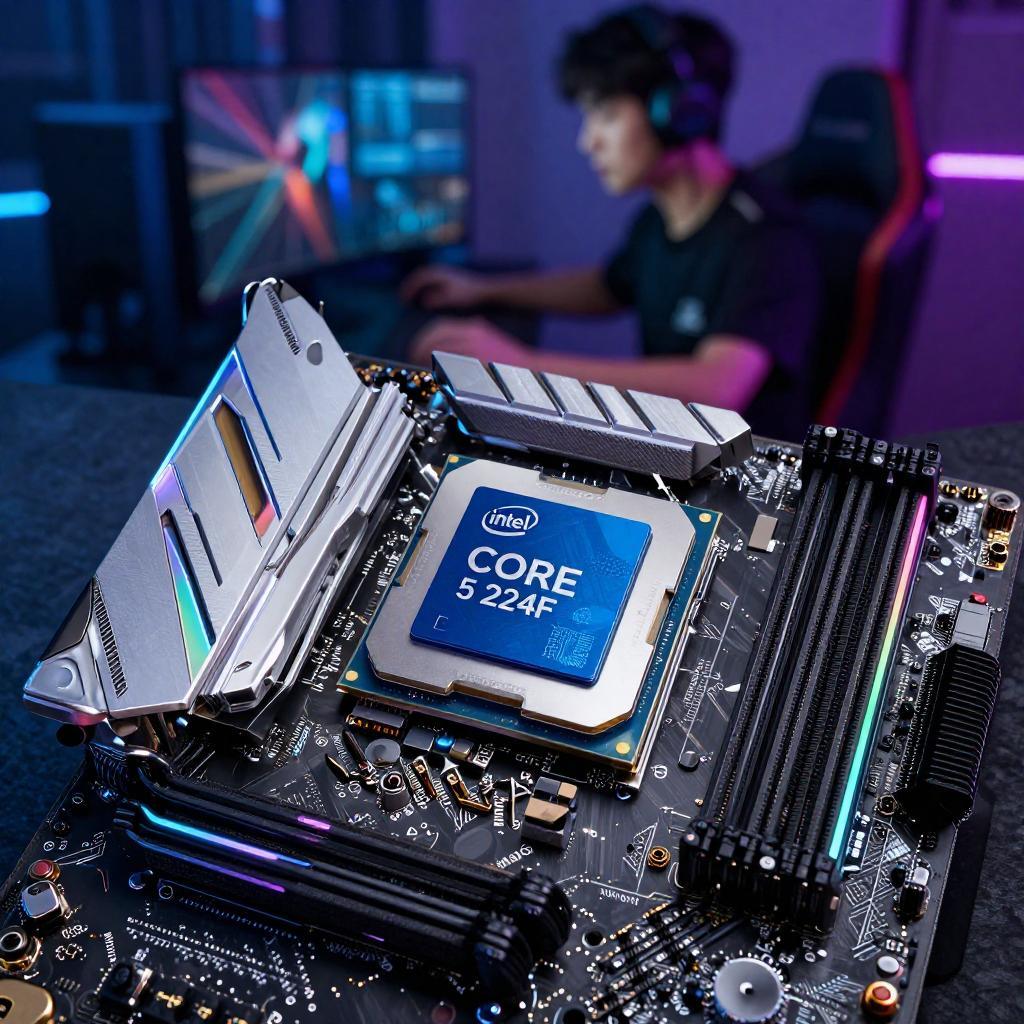
Intel’s Core Ultra 5 225F CPU, part of its Arrow Lake family, stands as an intriguing budget desktop processor option priced around $160 USD. Featuring 10 cores (6 performance and 4 efficiency cores), a 65W TDP, and modern architecture, it offers a power-efficient solution with competitive single-core performance. However, after nearly a year on the market, its gaming prowess and overall value remain highly nuanced when compared to AMD’s Ryzen 5 9600X and other budget rivals.
Specifications and Architecture
The 225F model combines 6 high-performance cores and 4 efficiency cores without hyperthreading, delivering a total of 10 cores and 10 threads. It boasts a base clock of around 3.3 GHz and can boost up to approximately 4.9 GHz on the performance cores. Intel has configured it with about 20 MB of smart cache, a reduction from higher-end models, and a power envelope capped at 65 watts, emphasizing efficiency and thermal management. These specs position it as a modest yet modern budget CPU suitable for mainstream desktop tasks.
Productivity and Synthetic Performance
In productivity workloads such as Cinebench and compression benchmarks, the 225F shows respectable single-core scores similar to the Ryzen 5 7600X and Intel’s own 14600K but falls short in multi-core performance. It generally matches or slightly underperforms the Ryzen 5 9600X in tasks like file compression and shader compilation. This reflects its orientation more towards gaming efficiency than heavy multi-threaded workloads.
Gaming Benchmarks: Strengths and Limitations
When it comes to gaming, the 225F delivers mixed but mostly modest results. In popular titles like Rainbow Six Siege and Marvel’s Avengers, the CPU can push well over 300 FPS at 1080p with medium to ultra settings, yet its gains over previous budget alternatives like the Intel 12400F are often limited to 6-12%. Comparatively, competitors such as the Ryzen 5 7500F and 9600X frequently outperform the 225F by margins ranging from 10% to over 20% depending on the game and settings.
In titles that are CPU-bound or heavily threaded, such as Counter-Strike 2 or Space Marine 2, the 225F maintains playable performance but remains behind higher-tier alternatives. Its gaming performance peaks at 1080p where high frame rates are achievable, but at 1440p or higher resolutions, GPU bottlenecks diminish CPU differences. Notably, in some scenarios like Spider-Man 2 on medium settings, it matches or slightly exceeds Ryzen budget chips, marking one of its less common strong points.
Price and Market Position
While initially launched at around $250 USD, the 225F’s price has gradually dropped to approximately $160 USD, making it more competitive amid budget processors. It slots just above Intel’s 12400F and below the 12600K in price, while AMD’s Ryzen 5 7500F and 7600X occupy similar price bands. Despite this, the 225F struggles to justify its price given that Ryzen’s Ryzen 5 9600X offers better multi-threading and often superior gaming performance. Platform costs including motherboards and DDR5 memory also affect overall value considerations.
Conclusion: Is the Core Ultra 5 225F Worth It?
The Core Ultra 5 225F presents a power-efficient, modern architecture CPU that can deliver competent 1080p gaming frame rates at an attractive price point if found around $160 USD. However, its marginal performance gains over older budget Intel parts and inconsistencies against comparable Ryzen processors make it a tough recommendation, especially for users who prioritize multi-core productivity or games that heavily leverage threading.
For budget-conscious gamers and PC builders, alternatives like AMD’s Ryzen 5 7500F or Intel’s own 14600K often provide better overall performance and platform longevity. Unless the 225F sees substantial price drops or platform cost reductions, it remains a niche choice primarily appealing to those seeking efficiency in compact builds rather than top-tier gaming or productivity value.