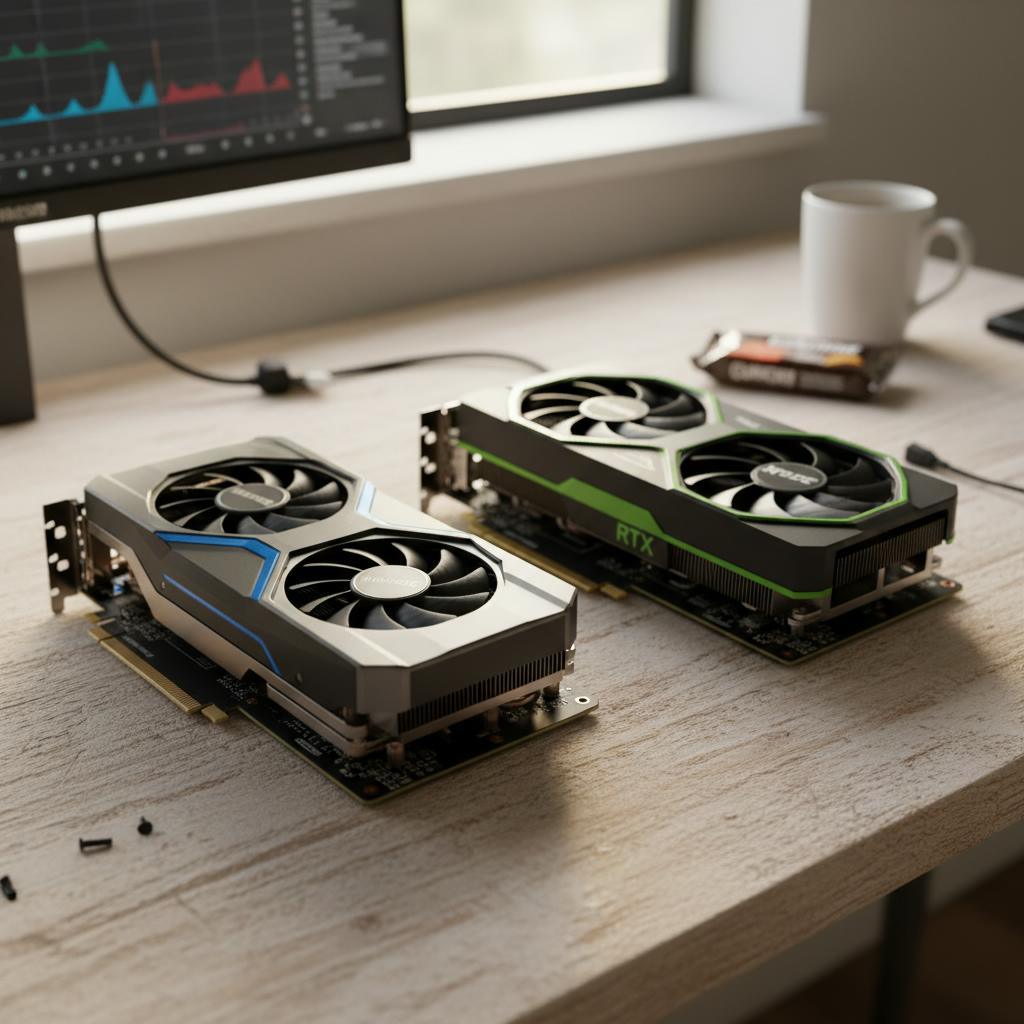
When shopping for a $250 graphics card aimed at entry-level gaming, two popular contenders stand out: the Intel Arc B580 and the Nvidia GeForce RTX 5050. Both offer appealing features and performance credentials, but choosing the best card depends on several nuanced factors including raw performance, VRAM capacity, and upscaling quality, especially when playing modern games at 1080p with upscaling enabled.
Performance and VRAM: Strengths and Trade-offs
The Intel Arc B580 tends to deliver stronger rasterization performance at 1080p, often pulling ahead in demanding titles due to its higher 12 GB VRAM and greater memory bandwidth (456 GB/s). This gives it an edge in games with heavy asset loads or higher texture settings, allowing for stable performance at ultra presets in many cases. Average frame rates and frame time stability (1% lows) are generally better on the B580.
Conversely, the RTX 5050 comes equipped with 8 GB of GDDR6 VRAM and 320 GB/s bandwidth, which can limit performance in newer games that start to demand more VRAM even at 1080p. While still competitive in raster performance, the smaller VRAM buffer sometimes forces the RTX 5050 into medium to high settings for smooth gameplay, especially in VRAM-heavy titles.
Upscaling Technologies: DLSS 4 vs XeSS
One of the biggest differentiators is upscaling tech. Nvidia’s RTX 5050 supports DLSS 4, a mature and widely adopted AI-powered upscaling engine that delivers superior image clarity, detail reconstruction, and stability. At 1080p, DLSS 4 generally produces sharper visuals with less temporal blur compared to Intel’s Xe Super Sampling (XeSS).
Intel’s XeSS on the Arc B580 is still evolving and less broadly supported across games. While it can boost performance effectively, it does not yet match DLSS 4’s refinement, especially in visual fidelity. Additionally, XeSS’s quality modes tend to render at lower resolutions than DLSS’s equivalent modes, which can impact perceived sharpness.
Game Compatibility and Driver Support
Driver polish and game compatibility present a mixed bag. Nvidia benefits from decades of driver maturity, meaning DLSS support is near-universal for modern games, often leading to smoother and more consistent play experiences. RTX 5050 users can expect reliable driver updates and broad game compatibility, especially for older or less demanding titles.
Intel’s driver ecosystem has improved significantly, focusing on newer games to optimize performance and stability. However, some titles still exhibit quirks or performance inconsistencies on the Arc B580 due to less driver maturity or optimizations lacking for some game engines like Unreal Engine. This can lead to frame time variability or graphical glitches in specific scenarios.
Power Efficiency and Ray Tracing
The RTX 5050 is notably more power-efficient, running at around 130 watts compared to the B580’s roughly 190 watts. For gamers concerned with thermals or power consumption, Nvidia’s card may be preferable.
Regarding ray tracing, both GPUs struggle at ultra settings at 1080p, but the B580 often manages somewhat better playable frame rates with ray tracing enabled, thanks to additional VRAM and memory bandwidth. Still, ray tracing is generally a challenging feature at this price tier.
Final Verdict for Entry-Level Gamers
For gamers focused on newer AAA titles and ultra settings at 1080p, the Intel Arc B580 emerges as the better choice with its higher VRAM capacity and stronger overall raster performance. It offers more headroom for demanding textures and future-proofing as games continue to increase VRAM requirements.
Meanwhile, if you prioritize mature driver support, widespread DLSS upscaling, and better power efficiency — and mostly play less VRAM-intensive or older titles — the Nvidia RTX 5050 remains a solid budget contender.
Ultimately, the B580 provides greater performance and value at $250, whereas the RTX 5050 excels in driver maturity and image upscaling technology. For entry-level 1080p gaming in 2025, the choice largely depends on your game library, preferences for visual quality versus performance, and willingness to trade power efficiency for higher VRAM and performance.